
Utah County Release Meaning
A release record documents the end of one booking at the Utah County Jail, also called the County Security Center. It does not always mean the person walked into the community. Utah County uses status O for released and status Y for taken to another facility. The release type then supplies the missing context. Bond, a promise to appear, recognizance, time served, a paid fine, or a dropped charge can support community release. Codes for another agency, immigration pickup, the Utah State Hospital, or Utah State Prison describe a handoff.
Release from a building also differs from discharge. Discharge means a sentence or term of supervision has ended. A person who posts bail is out of the jail while the case continues. A person paroled from prison is outside prison but remains under Utah Department of Corrections supervision. Someone sent to state prison has left the county facility yet remains confined. The record must be read as a set, not reduced to one date.
- Time served
- A jail departure after the required custody time has been credited.
- Parole
- Release from state prison into supervision ordered by the Utah Board of Pardons and Parole.
- Probation
- Court-ordered supervision that may occur without a state-prison stay.
- Discharge
- The end of a sentence or supervision term, not merely an exit from one facility.
- Detainer
- A hold or request from another authority that may prevent community release.
Utah County Release Types
The Sheriff’s official legend is unusually detailed. It lets a reader separate a true local release from a transfer. Read the code beside status, release date, other holds, and the case docket. A dropped charge on one booking, for example, does not rule out another hold.
| Code or outcome | Meaning | Next place to check |
|---|---|---|
B, BN, PB | Cash bail, bail bond, or property bond | Court case for the next required event |
PTA, ROJ, ROP | Promise to appear or a form of recognizance | Court docket and Sheriff release detail |
T, F, CD | Time served, fine, or charge dropped | Other bookings and holds, then the court case |
APP | Released by Adult Probation and Parole | UDC status, location, and case manager |
OTH, INS | Another agency or immigration pickup | The receiving custodian |
USH, USP | Utah State Hospital or Utah State Prison | The appropriate state system |
Why did the person vanish from Current Inmates? A roster is a present-status tool. Open the historical name result and look for status O, the release date, and the release type.
That combination is the strongest online county proof. A blank current roster result alone proves little because transfer, delay, spelling, retention, or an access limit can cause the same result.
Utah County Release Record Fields
A retained booking ties each departure to a distinct event. This matters when the same name has more than one arrest. The Sheriff detail can include charge and court information as well, but the fields below form the core Utah County release record.
| Field | What it shows |
|---|---|
| Booking number | The identifier that separates one jail event from another. |
| Arrest and booking dates | When the local custody event began and was processed. |
| Arresting agency | The agency connected with the booking. |
| Status | O means released; Y means taken to another facility; other status letters require context. |
| Release date | The date the booking record reports the departure. |
| Release type | Bond, recognizance, time served, court action, supervision, or transfer destination. |
The Utah County Sheriff inmate search displays the search choices, retention notice, and code legends used to interpret those fields.
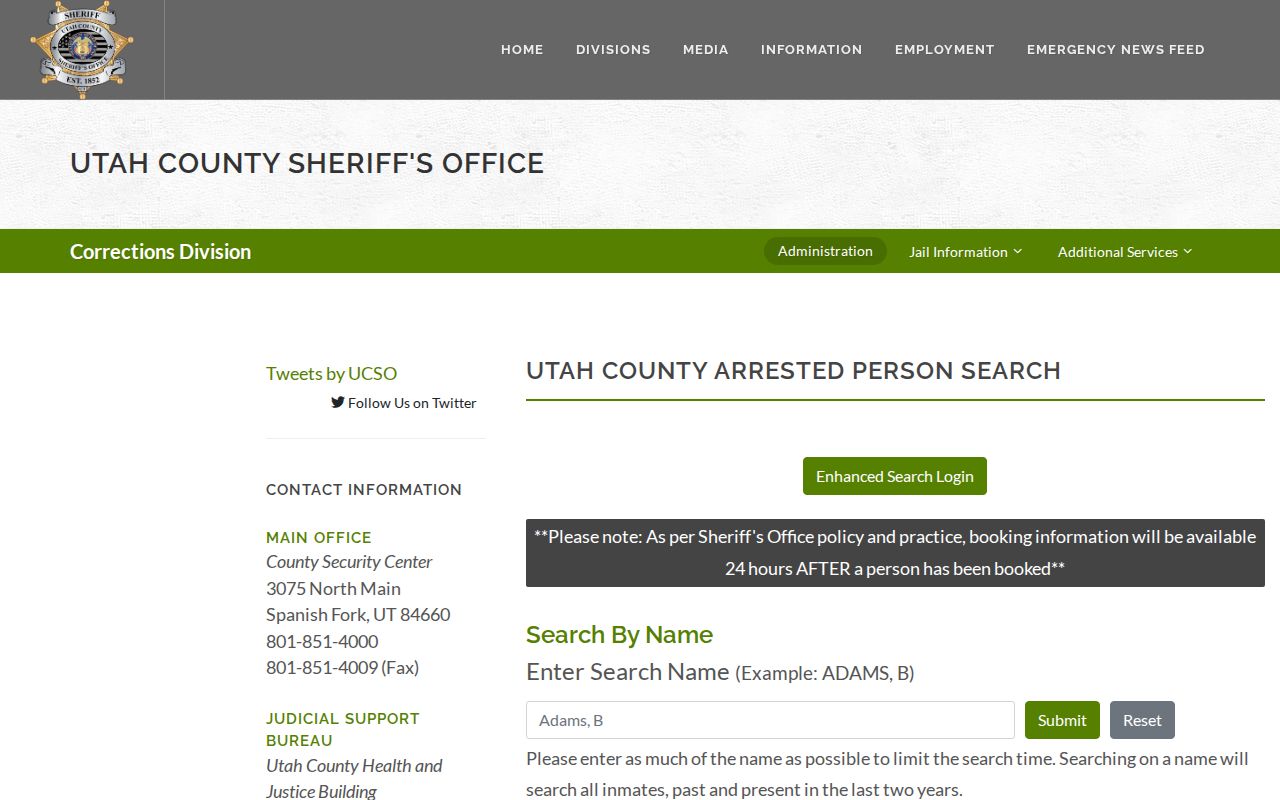
The captured official page shows why the name search, not only the current-inmate list, is the starting point for a completed Utah County release.
Online retention is limited and internally inconsistent. The detailed Sheriff policy says the photo and booking information remain for 30 days, after which the photo drops while the remaining text stays for one year and then drops. A helper on the same page says the name search covers past and present inmates from the last two years. Try the name search, but use the narrower policy when setting expectations.
Note: The 24-hour delay described by the Sheriff concerns initial booking publication, not a named list of people released that day.
Request Utah County Release Records
When an online booking has aged off or lacks needed detail, request the booking and release record from Utah County Sheriff Records under GRAMA. A focused request is easier to identify and redact. It should ask for the releasable version rather than private identifiers or an entire unrelated case file.
- Gather the full name, known aliases, an approximate arrest and release period, and the booking number if available.
- Specify the fields needed: booking number, booking date, release date, status, release type, and receiving agency if transferred.
- Use the county’s online NextRequest form. Ask for electronic delivery and a cost estimate before charges exceed a stated limit.
- Provide photo identification when Records requests it. A request made on another person’s behalf may require a notarized release under Utah Code section 63G-2-202.
- Allow the stated 10 business days, except when extraordinary circumstances apply, and preserve the response as the durable record.
Reports start at $15, while other items may add cost. That starting figure is not a promised price for a release record or booking photo. Utah’s law allows reasonable fees tied to duplication or compilation, so ask for an estimate.
The Utah County NextRequest form is the trackable online submission channel.
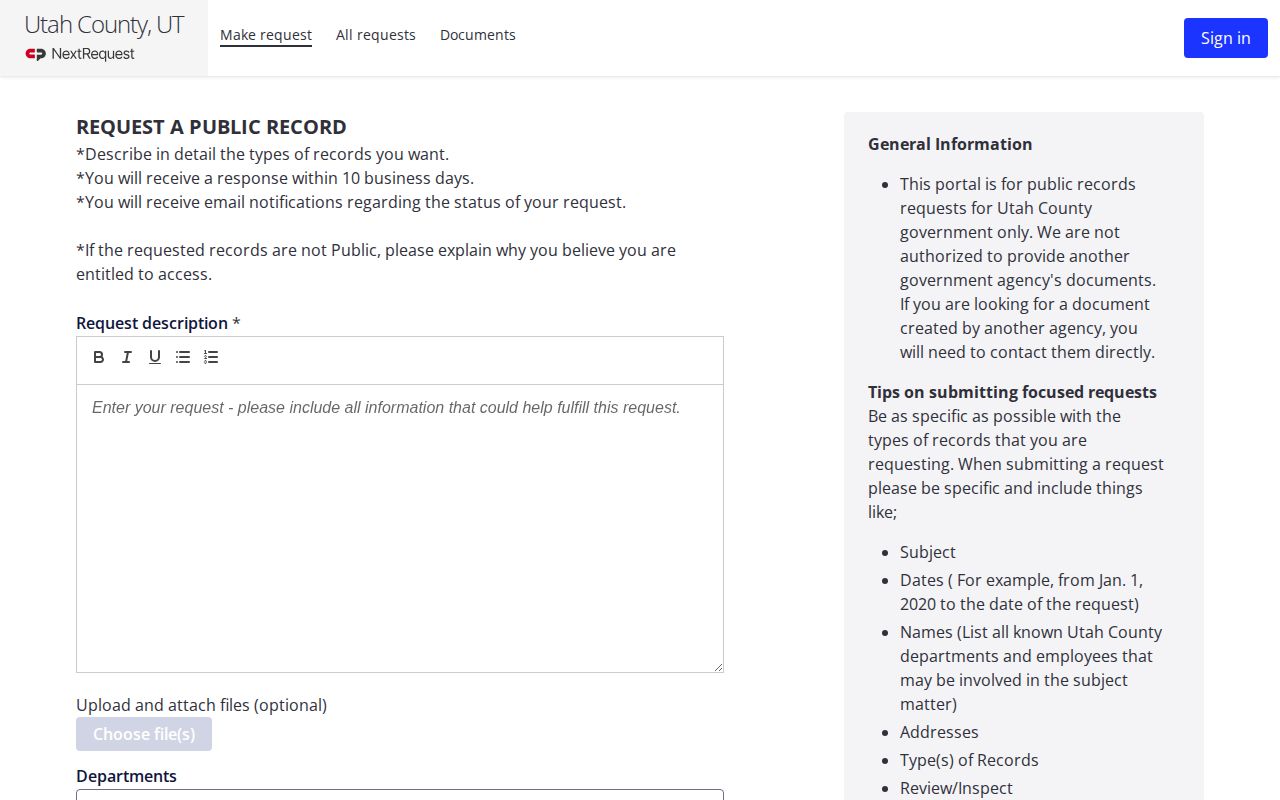
The request screen supports a precise written description that can survive after the short-lived public booking entry disappears.
Utah County Sheriff Records
3075 North Main
Spanish Fork, UT 84660
801-851-4500
SheriffRecords@utahcounty.gov
Monday through Thursday, 8:00 a.m. to 5:00 p.m.
Friday, 8:00 a.m. to noon
Utah County Release Record Law
Utah’s Government Records Access and Management Act, or GRAMA, supplies the access framework. Title 63G, Chapter 2 classifies public, private, and protected records. Section 63G-2-204 governs written requests and calls for reasonable specificity. Section 63G-2-203 addresses fees and generally excludes the first 15 minutes of staff time from a charge, subject to the statute’s current terms and exceptions.
A release file may mix public and nonpublic material. Utah County can redact juvenile, medical, victim, security-sensitive, private, or protected facts while providing the remainder. Sealing and expungement can also restrict later access. Expungement is a court and agency process under Title 77, Chapter 40a. It does not justify trying to reconstruct material that is no longer public.
Can a missing record prove no release occurred? No. Retention, spelling, transfer, redaction, sealing, expungement, or the limits of a given portal may explain the gap.
When Utah County Releases Happen
Utah County publishes a standard 3:15 p.m. release time for people who attended court that day. The jail asks pickup parties to wait until then because paperwork must follow the person back from court. That time is not a guarantee for all bookings. The orientation says release processing may take two to eight hours after Records Clerks receive the documents.
Two daily lockdowns create another practical delay. Releases are not processed from 5:15 to 6:00 a.m. or from 5:15 to 6:00 p.m., although the Booking Bureau operates around the clock. A judge’s order proves legal authorization. The later Sheriff status, date, type, or direct jail confirmation shows whether the physical departure was completed.
The Sheriff’s booking process gives the court-day timing and explains why paperwork can separate an order from the actual exit.
Note: Call the Corrections release-information line at 801-851-4200 when a same-day physical departure matters more than the web record.
Bail and Utah County Release
The jail accepts the exact bail amount. Credit cards carry a transaction charge and are not accepted by phone. Personal checks and loose change are not accepted. Cashier’s checks or money orders must be payable to “The Utah County Jail.” The Sheriff also states that staff cannot refer a caller to a particular bail bond company.
Payment still does not settle every custody issue. Another hold or warrant can block release. A warrant recall by itself generally does not direct jail staff to let someone go unless the paperwork states release by a judge or release on recognizance, often shortened to ROR. Verify the completed release in the booking status and date after the required documents arrive.
Utah County Release Volume
The Booking Bureau describes the jail’s scale through approximate operating figures. They are not a dated statistical report and should not be read as unique-person totals. One person can produce more than one case or booking. Still, the figures explain why a live roster changes fast and why a booking number is useful.
These are agency workload estimates from the Utah County Booking Bureau. They show operational churn, not the number of distinct residents who were released.
The Sheriff also publishes a changing count called “Inmates Released in the Last 24 Hours.” It is only an aggregate. It gives no names, release reasons, booking details, or photos, and Utah County supplies no person-level 24-hour or 72-hour release feed.
Property After Utah County Release
Original paper mail items are placed with inmate property and returned upon release, according to the Sheriff. Jail orientation also describes a person’s ability to authorize property release to family or friends. That release generally covers booked property except clothing and money. The published text does not promise a broader pickup method or timing.
Questions about stored property should go to Booking property at 801-851-4218. Keep the property issue separate from proof of release. A family member receiving an item does not establish that the person has left custody, and the jail record remains the better source for status, date, and type.
Find Utah County Released Inmates
Begin with the county system for a local arrest. Do not start with UDC unless the county record points to state prison or supervision. Search each matching booking and preserve the distinction between a release and a transfer.
- Search the Sheriff’s historical name form with at least three characters, then refine by first name or initial.
- Open each possible booking. Match the booking date, booking number, and other available context.
- Read status, release date, and release type together. Status
Oplus a community-release type is the key county result. - Allow for the stated publication and processing delays when the booking or court order is fresh.
- Follow
USP,APP,INS,OTH, orUSHinto the correct receiving system. - Use Sheriff Records and the court docket when the public booking is missing or too old.
The arrested-date form groups people by arrest date, not release date. Likewise, the live release statistic cannot identify a person. For jail contact and the exact local route, the Utah County Jail release page keeps the facility details together.
Utah County UDC Release Search
The UDC Offender Search covers people currently under Utah Department of Corrections supervision. It excludes people awaiting trial or not yet sentenced in county jail. That makes it useful for a Utah County person transferred to state prison and later released on parole, but not for every former state prisoner.
| Search or result field | How to use it |
|---|---|
| First and last name | Required for a name search; middle name is optional. |
| Offender number | Use as the direct identifier when known. |
| Date of birth | Appears in initial results and helps separate similar names. |
| Location and facility assignment | Distinguish prison custody from a community setting. |
| Release Date/Type | Read the exact date and type shown; the interface does not label a separate projected date. |
| Case manager and email | Identify the supervision contact shown on an expanded result. |
A paroled person can remain searchable because parole is UDC supervision. Once the person is fully discharged, the current-supervision limit means the record may disappear. Then use a final Board order, court docket, or UDC GRAMA response. Utah County parole and probation verification explains how the Board, AP&P, and the UDC result work together.
Utah County Release Court Records
Utah Courts Xchange can preserve the legal history after a short-lived jail entry is gone. Search the criminal case that matches the arrest. Docket entries may show bail, recognizance, dismissal, judgment, sentence, jail credit, probation, commitment to UDC, or a later termination. Utah County matters can arise in municipal justice courts, Utah County Justice Court, Fourth District Court, or an appellate court, so use the court code and case number rather than assuming one venue.
The official Utah Courts Xchange information page explains access to public case information and covered electronic district-court documents.
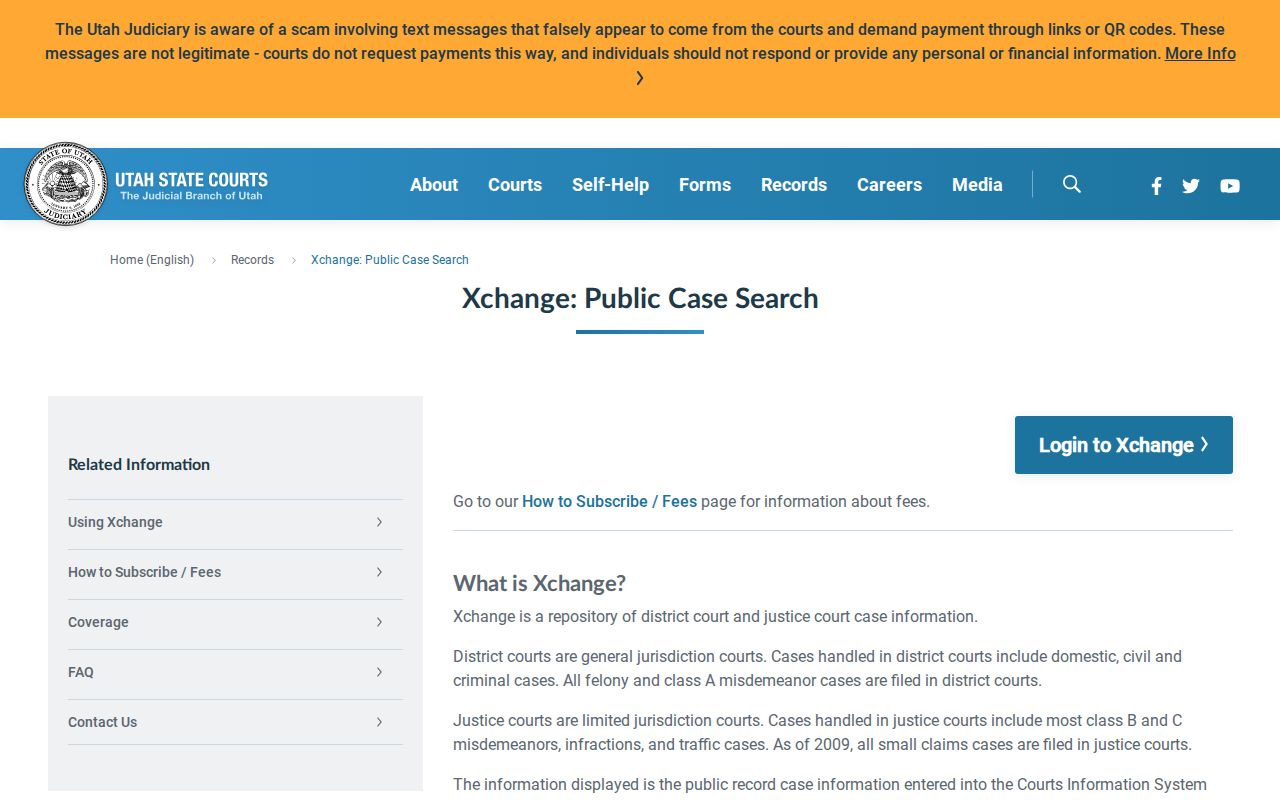
The court channel supplies the legal reason for a release or transfer. It does not prove the minute jail staff completed processing or whether a separate hold remained.
MyCase is different. It lets a party view that party’s own supported cases and is not a public name-search substitute. A public researcher uses Xchange or a courthouse terminal.
Utah County Release Notifications
VINELink for Utah receives custody information from participating agencies. Search a specific person, match the agency and identifiers, then read the exact status, location, event, and date. From the correct record, available phone, text, email, or application options may allow registration for a custody-change alert. An automated phone path can ask for a four-digit PIN to confirm receipt.
VINE is not a permanent booking archive. A no-result does not prove release, and a transfer alert does not prove community release. Agency participation, spelling, timing, record scope, or another custodian can explain the outcome. Confirm the event through the Sheriff, UDC, Board order, or receiving agency.
The Utah Sex and Kidnap Offender Registry is narrower. It reflects an offense-specific registration duty, not a general history of Utah County releases. Presence does not establish the exact jail release date or parole status, and absence proves neither release nor the lack of a conviction.
Note: Check the agency shown in the live VINE record because participation and reported event types can change.
Utah County Immigration Release Codes
The local legend defines INS as “Immigration pick-up.” It shows that the Utah County booking ended with an immigration handoff. It does not show that the person entered the community. No sufficiently current official source in the research establishes that Utah County now has an active contract to house ICE detainees, so the code should not be stretched into that claim.
Use the ICE Online Detainee Locator to check current immigration detention by A-number and country of birth or by the biographical fields offered. It is not a historical release archive. A missing result can reflect transfer, removal, release, delay, a data mismatch, or scope limits. The ICE field office is the next route when the locator cannot resolve the handoff.
Utah County Federal Release Search
No federal prison is located in Utah County. The Federal Bureau of Prisons locator should only be used when federal jurisdiction and a BOP record are established. It covers federal prisoners incarcerated from 1982 to the present and can display a historical “Released” result with a date. BOP also warns that sentence and release information may not be current.
The BOP Inmate Locator is the official historical federal search.
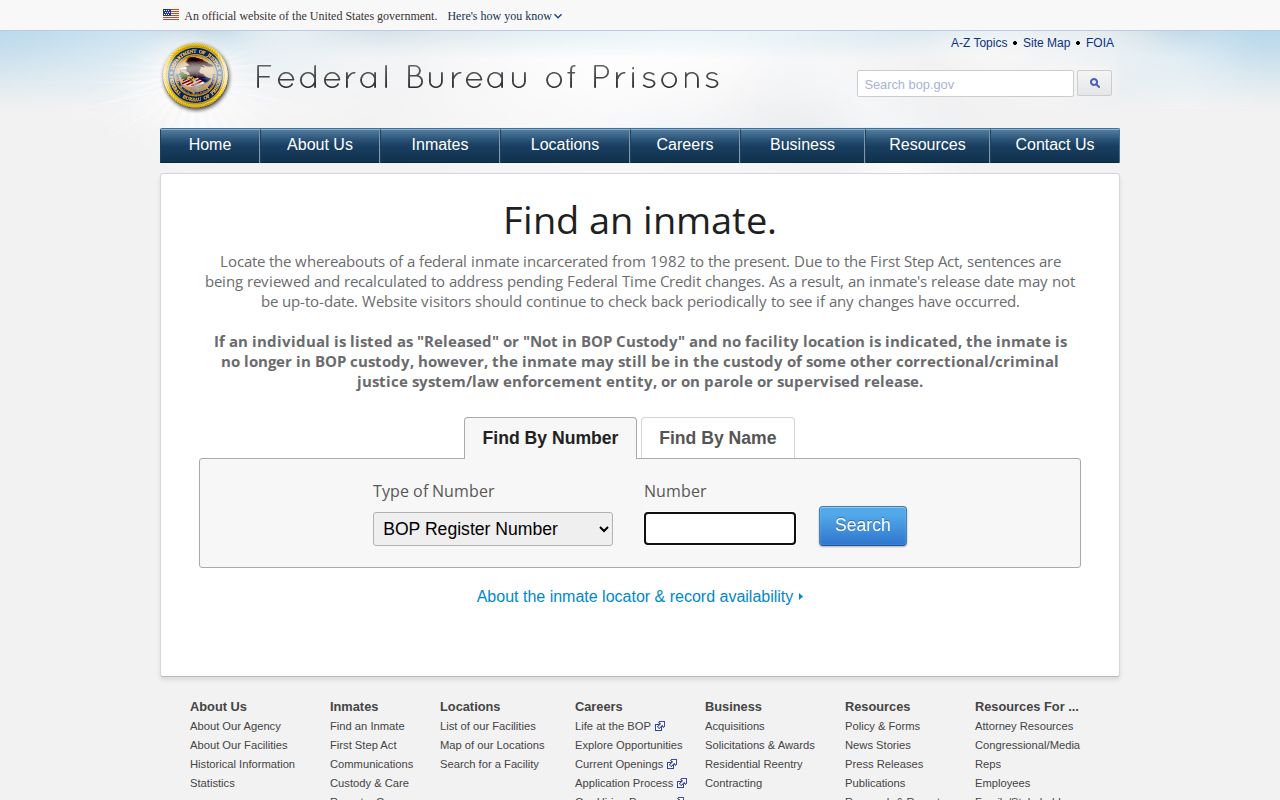
The federal result does not answer an unrelated Utah County jail booking or immigration hold. A person in federal pretrial or transport custody may instead require the District of Utah docket and the U.S. Marshals Service.
Compare Utah County Release Sources
Each system answers a different part of the custody trail. Use the source tied to the agency that held the person, then confirm any transfer with the next custodian.
| Situation | Best first source | What confirms it |
|---|---|---|
| Still tracked by county jail | Current Inmates | Current booking and status |
| Past Utah County booking | Historical Sheriff name search | Status O, release date, and type |
| State prison or parole | UDC Offender Search | Location, facility assignment, Release Date/Type, and Board order |
| Case outcome | Utah Courts Xchange | Docket entry or filed order |
| Federal sentence | BOP locator | Federal release result, docket, or BOP record |
| Immigration handoff | ICE locator | Current ICE result or agency confirmation |
For a record no longer online, the fallback is a narrow request to the agency that created it. Sheriff Records handles the county booking and release record. UDC records and Board orders address state parole or final discharge.
Utah County Release Facility
Utah County has one detention facility in the project map: the Utah County Jail / County Security Center. The Utah County Sheriff’s Office Corrections Division operates it at 3075 North Main in Spanish Fork. A supported local outcome can return a person to the community. Codes Y, OTH, INS, USH, and USP instead route the search to another facility or agency.
Utah County Jail / County Security Center
3075 North Main
Spanish Fork, UT 84660
801-851-4302
Release information: 801-851-4200
Booking: 801-851-4210
Property: 801-851-4218
A transfer to UDC, another county, immigration custody, or a hospital is not a second Utah County facility. It is the next branch in the record trail.