
Utah County VINELink Coverage
VINELink for Utah is a custody-status and notification service. Participating custodial agencies send information into the system. That design makes it useful around a current or recent custody change, but it is not a permanent archive of every Utah County booking or every person once released.
Participation and event types can change. Before relying on a result, confirm that Utah County Jail / County Security Center or the relevant UDC custodian appears in the live agency selector or on the matching record. Do not claim statewide coverage from the Utah landing page alone. A participating county record and a state corrections record may also use different fields or event labels.
VINELink is strongest when the reader already knows whom to check. It can corroborate a reported release, transfer, or present custody status. It cannot explain the full court basis for release, give a durable case history, or establish final sentence discharge merely from a no-result. The Sheriff's booking record, UDC result, Board order, or court docket must fill those gaps.
The official Utah VINELink entry shows the state search and notification path.
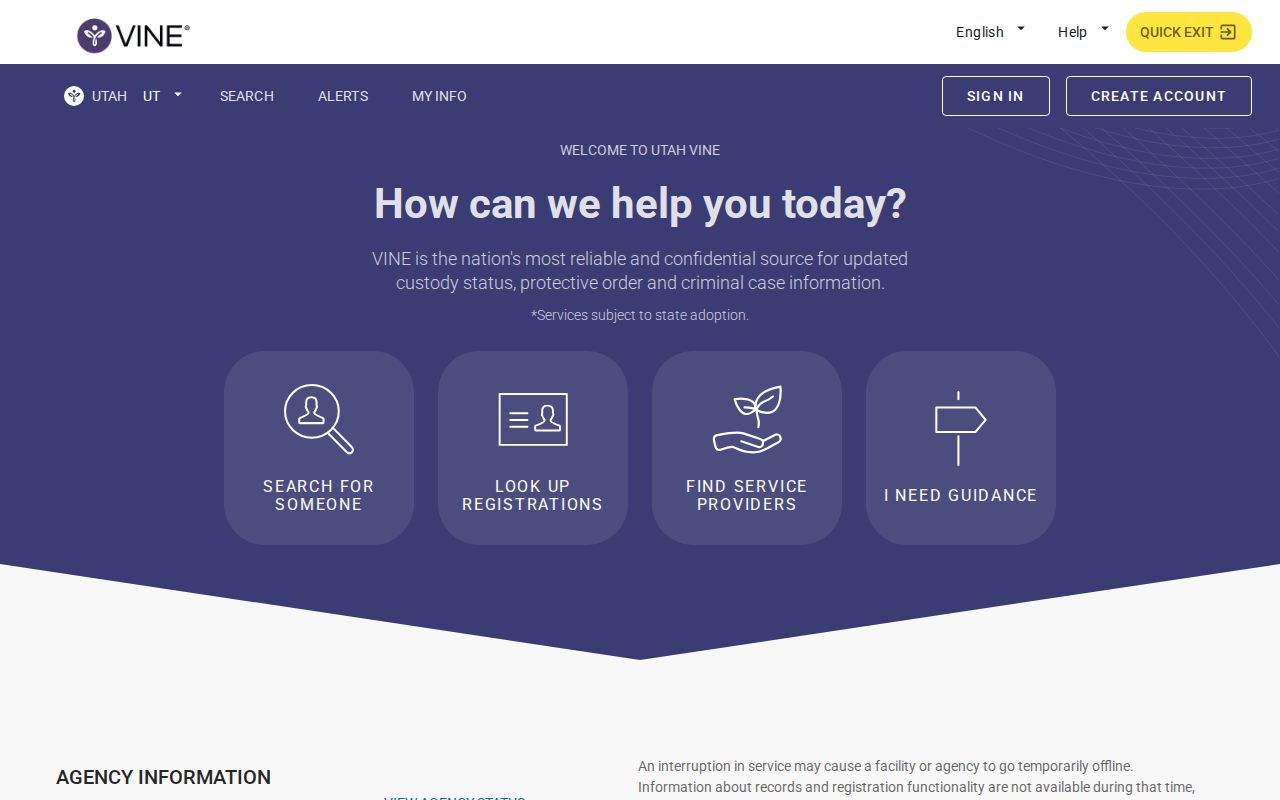
The screen is the proper starting point for a specific-person check, with agency matching and confirmation still required after a result appears.
Search a Utah County Inmate
Gather the person's full name and any known booking or offender identifier first. Spelling matters. Similar names also require care because a custody event belongs to the record and agency displayed, not merely to the first name match.
- Open VINELink and choose Utah.
- Select the available custody or offender search.
- Enter the person's last name and first name, or the identifier offered by the current form.
- Compare possible matches by agency and the public identifiers shown. Do not choose solely because the name looks close.
- Open the matching record and read the exact custody status, location, event or date, and reporting agency.
- If the record reports release, note the event wording and then confirm it with the source custodian.
A no-result is not a custody finding. The cause may be a spelling variation, an agency that does not participate, delayed transmission, a transfer, or archival behavior after release. Return to the source system that should hold the person. The Utah County released inmate search explains the county booking, UDC, court, federal, and records-request branches.
Note: Search PINs are not required; a four-digit PIN belongs only to the classic automated-phone notification workflow.
Utah County VINELink Release Fields
Read only the labels provided on the current record. VINELink data varies by contributing agency, so no single field inventory can promise that each Utah County Jail or UDC result looks identical. The core items documented by the Utah research are agency, custody status, location, and event or date, along with the name or identifier used to match the person.
| Displayed item | What it can establish |
|---|---|
| Name or offered ID | Helps match the record to the intended person. |
| Reporting agency | Identifies which participating custodian supplied the event. |
| Custody status | States the status currently reported through VINE. |
| Facility or location | Shows the reported custodian or place associated with the record. |
| Event and date | May report release, transfer, or another custody change in the agency's terms. |
A result that explicitly says released is a VINE custody-event confirmation. It still does not identify every legal consequence. Release from the Utah County jail on bail leaves a case pending. Release from state prison on parole leaves UDC supervision active. A transfer may end custody at one facility while custody continues elsewhere.
Do not translate a transfer into community release or a release into final discharge. Compare the VINE event with the Sheriff release type for county custody, UDC Release Date/Type and the Board order for state prison, or the receiving agency when the event is a handoff.
Register Utah County Release Notifications
Registration starts from the correct person's record. Available channels can include phone, text, email, or an application option, but the current interface controls what is actually offered. Keep the confirmation because it helps show that registration finished.
- Open the matched custody record and select Register for Notifications.
- Choose one of the phone, text, email, or app channels shown for that record.
- Supply the requested contact information and check it for errors.
- For automated phone calls, create the four-digit PIN used to confirm receipt. For email or account methods, follow the displayed confirmation or link.
- Keep the registration confirmation and update the contact details if they change.
The PIN confirms delivery of an automated phone notice. It is not a search credential and should not be entered into unrelated sites. Channel names and prompts can change, so follow the live Utah screen instead of an old generic tutorial.
An alert is a prompt to verify. It may report release, transfer, or another custody change. Contact the Sheriff for a county event, or compare a state event with UDC and the Board. Do not rely on the alert time as the exact moment the person physically crossed a facility exit.
Confirm Utah County Jail Release
For a local booking, the Utah County Sheriff historical name search is the direct source. A completed community departure is best supported by status O, a release date, and a release type consistent with release. Current Inmates shows people the Sheriff still tracks; disappearance from that list is not enough.
Release codes also show where a person went. Bail, recognizance, promise-to-appear, time-served, fine, and supported dropped-charge outcomes may align with community release. By contrast, status Y or release types OTH, INS, USH, and USP describe another custodian or institution. A VINE transfer alert should be read with those codes before anyone assumes the person went home.
The Sheriff's public booking data can lag initial booking by 24 hours. Physical release processing can also continue after an order arrives. For a fresh event, call the Utah County Jail / County Security Center at 801-851-4302 or use the identified inmate-information line at 801-851-4200. For an older no-result, request the release record through Sheriff Records.
Confirm Utah County State Release
A Utah state-prison event belongs in the UDC Offender Search as well as VINELink when the custodian participates. UDC searches only people currently under its supervision. It can show a person who left prison on parole, but a fully discharged former offender may no longer appear.
Open More Information and read Location, Housing Facility, Release Date/Type, Case Manager, and Case Manager Email. UDC includes incarcerated people too, so Release Date/Type alone cannot prove community placement. Pair it with a non-prison location and the Board's final decision or order. A parole release is physical release under supervision, not final sentence discharge.
If a person is absent after supervision ends, use a UDC GRAMA request, Board decision history, and the criminal docket. Those channels outlast a live notification service and can distinguish parole release, parole termination, and sentence discharge.
Utah County Notification Channel Sweep
VINELink is only one branch. Xchange can preserve public criminal case information and electronically filed district-court documents within its coverage. It may show bail, a release order, dismissal, judgment, sentence, probation, or termination. That docket explains legal authority, but it does not prove when jail staff completed physical release.
The Utah Sex and Kidnap Offender Registry is an offense-specific post-release system. A record there can support a current registration duty and public registration status. It does not give the Utah County jail release details and does not, by itself, prove parole. Registration can outlast both custody and supervision. Absence has no safe meaning without the registry's eligibility and matching rules.
Formal records requests remain the durable fallback. Ask the Sheriff for a booking and release record when county detail is missing. Ask UDC for releasable release, parole, termination, or discharge information when a fully discharged person falls outside the public current-supervision search. State GRAMA rules allow redaction of private and protected material, so request the releasable portion rather than assuming the whole file is public.
Note: Courts explain the order, VINE reports participating custody events, and the originating custodian confirms the actual release or transfer.
Utah County VINELink Limits
VINELink does not replace the Federal Bureau of Prisons inmate locator. For a federal prisoner with a BOP record, use the BOP historical locator and federal docket. A pretrial or pre-designation federal detainee may require the District of Utah court or U.S. Marshals route instead. BOP itself warns that older and non-BOP custody records have limits.
The BOP locator records explanation documents those federal limits.
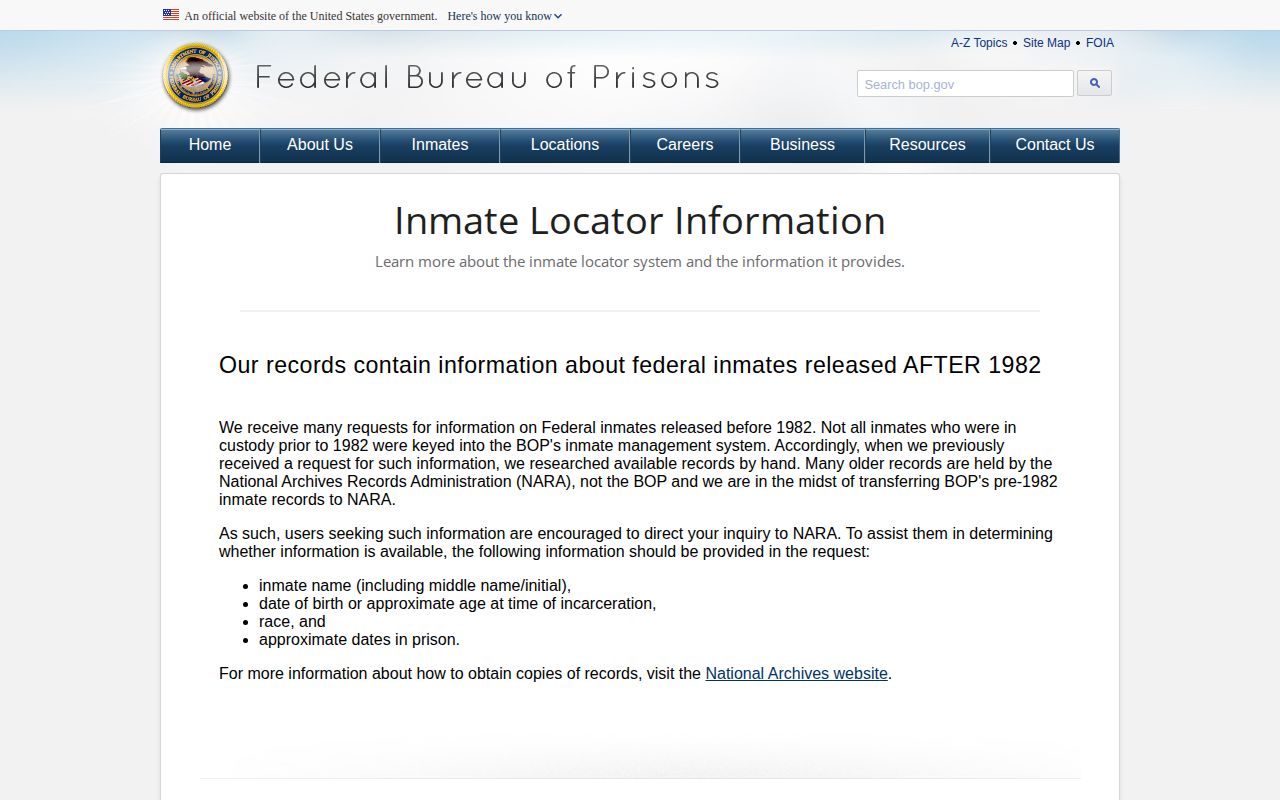
The federal tool is a separate system, which is why no Utah VINELink result can settle a BOP release question.
VINELink also does not replace ICE's detainee locator. If a Utah County release record says INS, the county booking ended through an immigration handoff. It does not mean community release. Use ICE to check the next custody stage. An OTH code similarly requires the receiving agency, and a USP code sends the search into UDC.
Transmission can lag, agencies can change participation, and event labels vary. Confirm an alert through the office that created the underlying record. The strongest conclusion uses both systems: VINE for the notice and the custodian's own release, transfer, or discharge evidence.
Keep the original notice details when following up, including the agency name, event wording, person identifier, and reported date. Those details help the Sheriff, UDC, or another custodian locate the same event without turning a general question into a guess. If an alert conflicts with a live roster, ask whether processing or data transmission is still underway.