
Utah County Parole Versus Probation
Utah divides the release decision from the work of supervision. The Utah Board of Pardons and Parole decides whether a person serving a state-prison sentence may leave prison on parole and when parole or the sentence may terminate. The Utah Department of Corrections Adult Probation and Parole division, called AP&P, carries out community supervision. AP&P supervises parolees under Board authority and probationers under Utah district-court orders.
Probation is a court disposition. It can start without a state-prison stay, although a court may impose jail time as part of the case. Parole begins after release from state prison. In both cases, physical release and legal discharge are different events. A Utah County parole record can show that someone left prison while the sentence continues. A probation order can keep a person under court conditions after release from the Utah County Jail / County Security Center.
| Point | Parole | Probation |
|---|---|---|
| Who orders it | Utah Board of Pardons and Parole | Utah district court |
| What comes first | A state-prison term | A court sentence, sometimes without prison |
| Who supervises | UDC Adult Probation and Parole | UDC Adult Probation and Parole |
| Key ending record | Board termination, expiration, or discharge action | Court or AP&P completion and termination record |
The shared supervising agency can make the two statuses look alike. The source order resolves that problem: Board materials control parole decisions, while the sentencing docket controls probation. The Board's parole explanation and the UDC AP&P page describe those roles.
- Parole
- Release from prison into community supervision before the sentence or supervision has fully ended.
- Probation
- A court-ordered form of supervision that may be imposed instead of, or along with, confinement.
- Discharge
- The formal end of the sentence or supervision, not merely the day a person leaves a facility.
- Absconder
- A supervised person alleged to have evaded required contact or supervision.
Verify Utah County Post-Release Supervision
There is no separate public person-search tool on the AP&P page. The practical starting point is the UDC Offender Search. It covers people currently under UDC supervision, which can include a parolee living in the community and a probationer. It also includes incarcerated people. Therefore, a name match by itself does not show community release.
- Search by offender number when known. Otherwise enter first and last name, with the middle name if it helps separate similar results.
- Compare the offender number, name, and date of birth. Open the matching More Information result.
- Read Location and Housing Facility together. A prison facility points to custody, while a community location may support active supervision outside prison.
- Record the exact Release Date/Type plus the case-manager name and email. Do not relabel that field as final discharge.
- For parole, check the Board decision and effective date. For probation, check the Utah district-court docket and current AP&P contact.
The public UDC result exposes Offender #, Name, Location, Housing Facility, Release Date/Type, Case Manager, and Case Manager Email. It excludes people awaiting trial or not yet sentenced in county jail. It can also stop returning a person once all UDC supervision has ended. A missing result is therefore not proof of release or discharge. The durable fallback is the Board order, court docket, or a UDC records response.
The official UDC search page shows the current-supervision limitation and search entry.
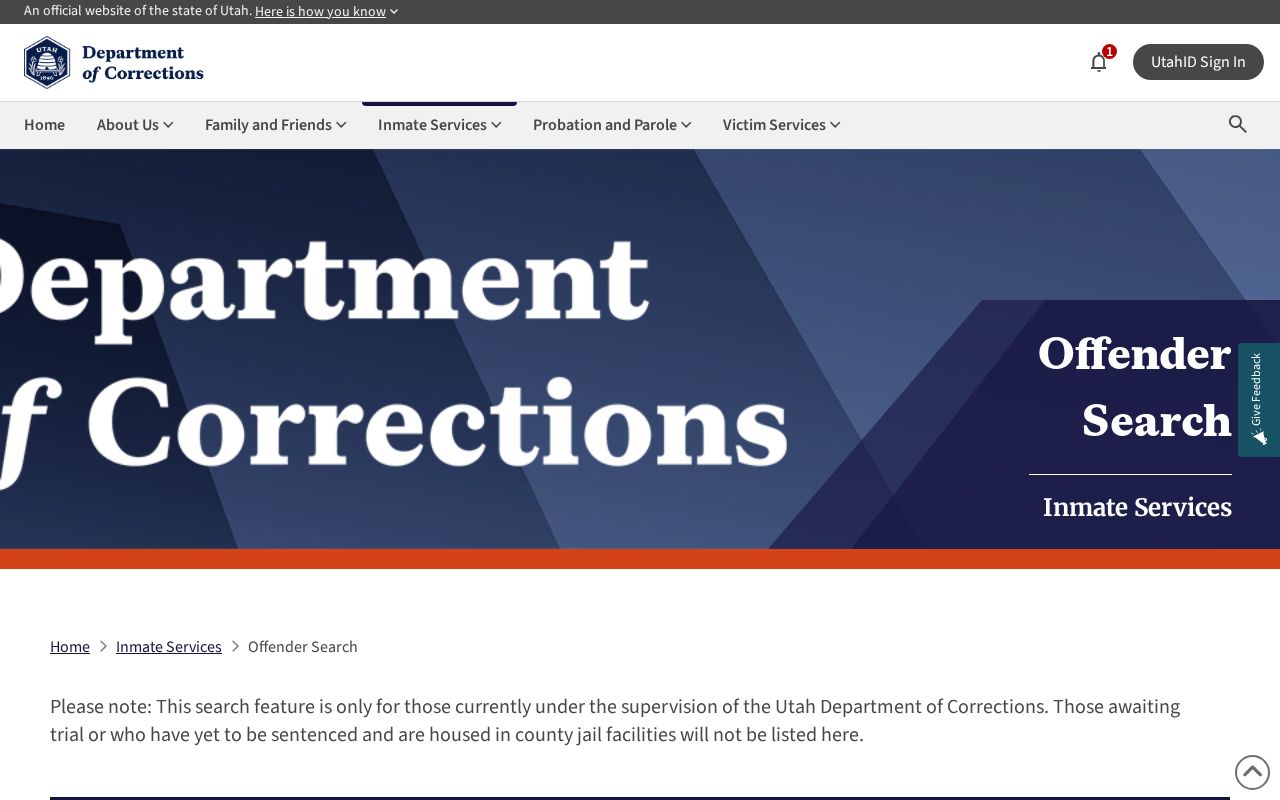
That limitation matters most after discharge: the absence of a former offender can reflect the search scope rather than a new custody event.
Note: A Utah County jail booking is confirmed through Sheriff records, not through the UDC search for sentenced or supervised people.
Utah County AP&P Region 4
UDC's regional map assigns Utah and Wasatch counties to AP&P Region 4 in Provo. When an offender result lists a case manager, that person and email are the most specific agency lead. If the result confirms current supervision but does not make the office clear, Region 4 can route a status question. The statewide AP&P division number is another fallback.
Adult Probation and Parole Region 4
150 East Center Street, Suite L100
Provo, UT 84606
Region 4: 801-374-7633
AP&P Division: 801-545-5908
The 2026 AP&P Region Map is the source for the local assignment. Published research did not establish public counter hours, so call before planning an in-person visit. Never assume the closest office supervises a particular person when the result supplies a named case manager.
The official AP&P page shows the division and its statewide role.
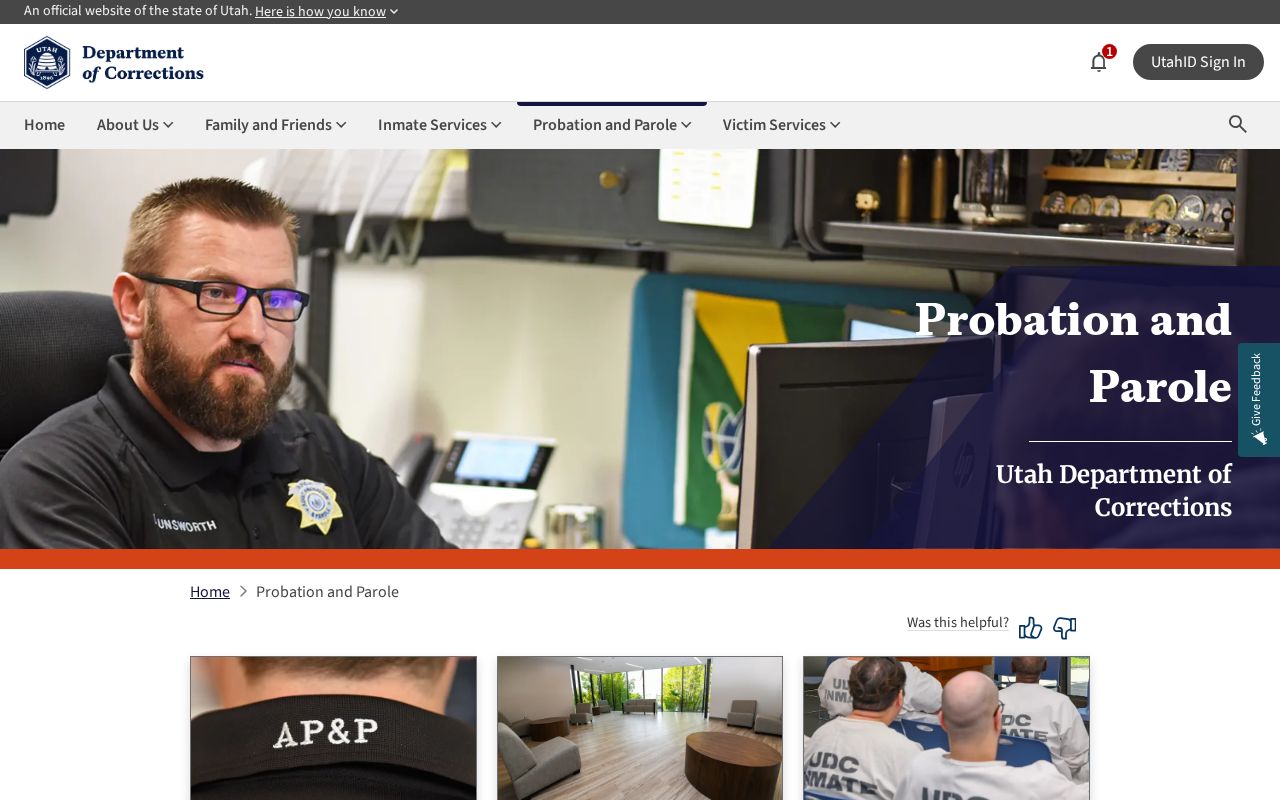
Use this agency route for present supervision questions, while Board orders and court records explain why that supervision exists.
Utah County Supervision Violations
A released person can remain subject to conditions set by the Board or court. The Board's current material gives examples such as treatment, residence in a community correctional center, abstinence, monitoring, and no-contact terms. These are examples, not a basis for guessing any individual's rules. The signed order and supervising agent are the proper sources for a particular case.
When AP&P alleges that a supervised person absconded, agents may seek an arrest warrant and coordinate with UDC fugitive teams and other agencies. AP&P does not publish a statewide public absconder list on its main page. Check the current UDC location and status, then review Board violation proceedings when parole is involved. An old parole date only records a prior transition. It cannot prove where the person is now.
The Board recognizes parole-violation and evidentiary hearings. An allegation may be admitted, denied, or met with a no-contest plea. Depending on the process, an allegation can be dismissed, a warrant can be recalled and parole reinstated, or the issue can move to an evidentiary hearing. The official hearing and review types give the correct context.
Utah County Parole Board Records
The Board search is a distinct channel from the UDC result. It can return upcoming hearings, pending decisions, prior decisions, final expiration information, and downloadable decision or order PDFs. Search by offender name or number and use a date range when reviewing events. The hearing calendar search limits a query to seven days, so a longer span requires consecutive, nonoverlapping ranges.
A scheduled hearing does not establish release. An Original Hearing considers early release. A Rehearing means no date was granted at that stage. Redetermination can revisit an outcome, while Rescission can remove a date that had been granted. Parole Violation proceedings concern someone already released under supervision. A final termination or expiration record is the evidence that supervision or the sentence ended.
The Board hearing and decision search is the source for those records.
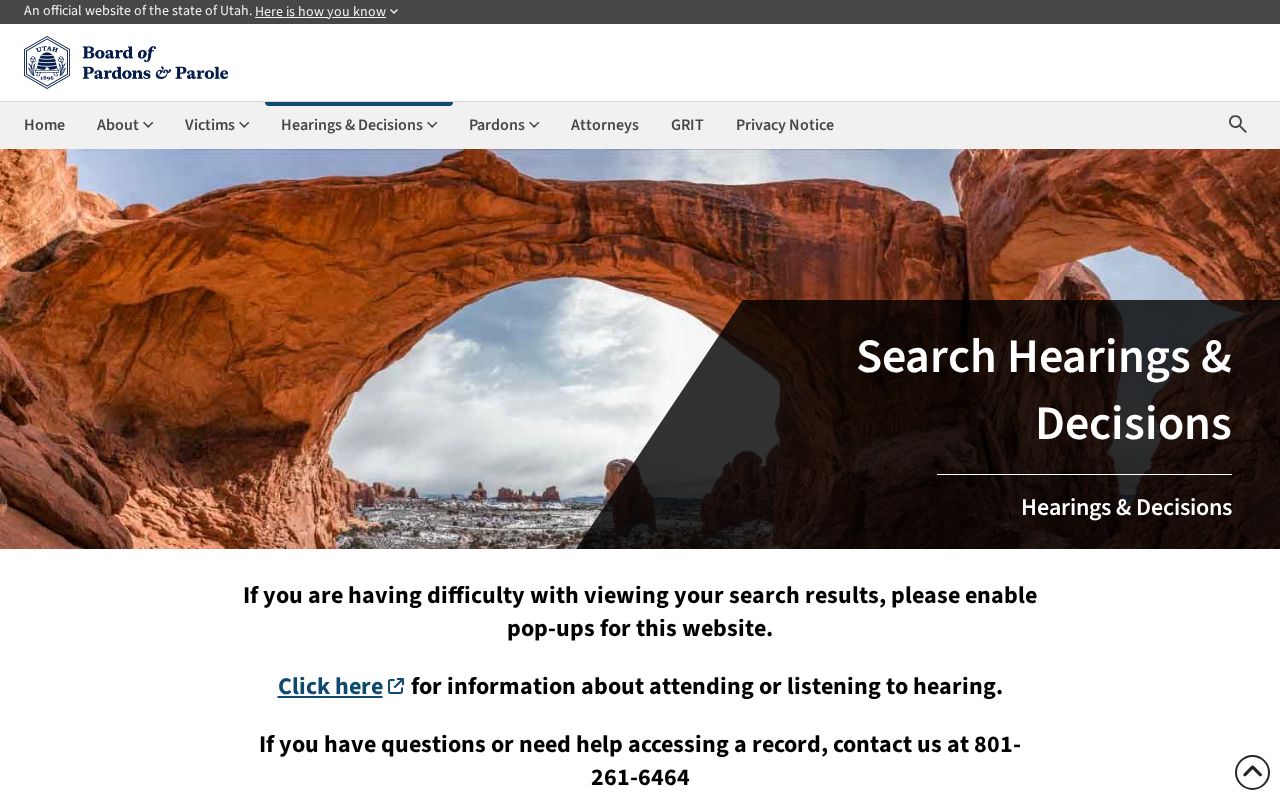
Read the downloadable order and its effective date, then compare it with UDC location, housing, and Release Date/Type.
Note: Board eligibility under Utah law is not the same as a final order granting release on a stated date.
Utah County Release Property Return
Post-release needs can start with property held at the Utah County Jail / County Security Center. The Sheriff says original paper mail items are placed with inmate property and returned upon release. Jail orientation also describes an inmate-authorized property release to family or friends. That release generally covers booked property except clothing and money.
Those published rules do not establish a broad pickup process for every circumstance. Property may already have been released, may remain tied to booking procedures, or may require authorization from the person. Direct property questions to Booking property at 801-851-4218. Confirm the current process before travel, and distinguish jail property from items held as evidence in a case.
The Sheriff's inmate-services information explains the treatment of original mail, while jail orientation addresses authorized property release. These details concern the county jail transition. They do not describe UDC prison property or AP&P supervision terms.
Utah County Supervision Discharge
Parole time outside confinement generally counts toward the sentence when the person remains free of violation. Utah Code §76-3-202 also says unauthorized absence or evasion tolls the parole period, which means that time may stop counting. The Board retains authority to parole or discharge within legal limits. This is why a release date, parole termination date, and sentence discharge must be read as separate events.
For parole, obtain the final Board decision or order and verify its effective date. For probation, inspect the sentencing case for an order ending probation or otherwise closing the obligation, then confirm with AP&P if current supervision remains unclear. A fully discharged person may vanish from the UDC current-supervision search. Use the records path described in the Utah County released-inmate search when a durable release or discharge record is needed.
Utah GRAMA permits a specific request for releasable records, but private or protected parts may be redacted. Ask UDC for the final release, parole, termination, or discharge date and type, identify the person carefully, and accept segregated public portions. Physical release from prison is not final sentence completion unless the governing order says so.
The Board and court records should be checked against current agency information because a later violation, corrected order, or expiration can change the status shown by an older document. Preserve the effective date and event label from each source. If UDC no longer returns the person, a specific records request can resolve whether the search ended because supervision ended or for some other record-scope reason.